Reviewed and updated September 10, 2026. This article provides general public-health and referral guidance, not testing, medical, legal or engineering advice.
First: read the result, location and test conditions
EPA recommends taking action to reduce radon when the result is 4 pCi/L or higher. That does not mean you need to leave the house tonight or diagnose anyone's health. It means the measured concentration reached the federal action level and deserves a methodical response.
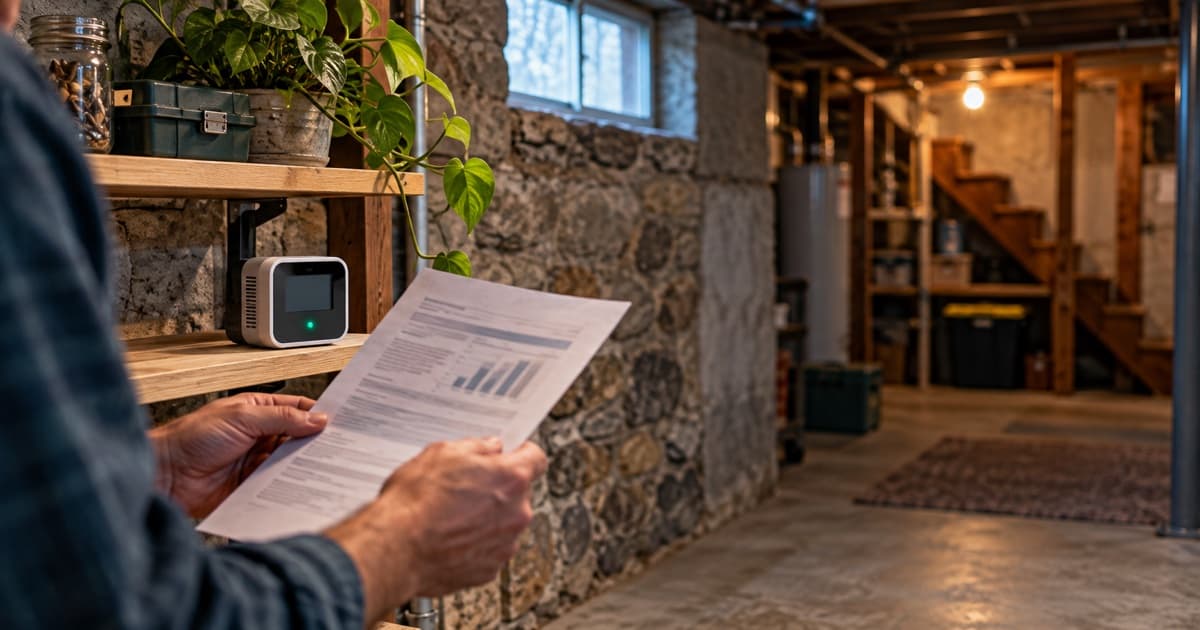
Check whether the result is an average, which floor was tested, how long the device ran and whether closed-house conditions were maintained. Keep the complete laboratory or monitor report. A number copied into a text message is less useful than the document that explains how it was produced.
Decide whether confirmation is needed
The confirmation path depends on the test. EPA's buyer and seller guide provides transaction-specific options for short-term testing, including paired passive devices, sequential tests and a continuous monitor for at least 48 hours. A long-term result of 4 pCi/L or higher supports fixing the home.
Do not delay indefinitely while chasing a perfectly stable number; indoor radon varies. Use the instructions for the device and current NYSDOH or EPA guidance, or ask a certified testing professional when the conditions were questionable. A very high result warrants prompt professional discussion rather than repeated casual screening.
Do not panic—and do not try random foundation fixes
Opening windows may temporarily change indoor concentration, but it is not a durable mitigation system and it can invalidate a short-term confirmation test. Permanently sealing a sump or drain without understanding its drainage role can create water problems. Buying a fan before evaluating the foundation can produce a system that does not control the needed zones.
The useful immediate actions are administrative: preserve the report, list the foundation sections, note any sump or crawlspace, and identify your deadline. If this is a purchase, share the result with the professionals handling the transaction and keep medical or legal questions with qualified advisers.
Mitigation is usually a pressure-control system
Active soil depressurization commonly uses a fan and sealed pipe to draw soil gas from beneath a slab or membrane and exhaust it outdoors. The contractor determines suction points, crawlspace treatment, pipe route, fan location and sealing based on the building.
Ask the mitigator to explain how the design addresses each foundation zone and what diagnostic evidence supports it. The Elmira mitigation article covers system components, while the regional cost article helps compare estimates.
Verify the result after the work
A post-mitigation radon test is the performance check. A pressure gauge shows that the fan is creating pressure difference; it does not measure indoor radon. Ask when the post-test should begin, who supplies it and how the results will be documented.
Keep the system diagram, warranty, fan information and test reports with the home records. Retest after relevant structural or occupancy changes and according to current public-health guidance. If a lower level becomes regularly occupied, EPA says that change is a reason to test on that level.
Sources
Primary guidance used for this article
We use government and public-health sources, distinguish historical datasets from current household measurements, and do not invent local results. Read our editorial policy.
- U.S. Environmental Protection AgencyHome Buyer's and Seller's Guide to Radon
- New York State Department of HealthRadon information for New York residents
- U.S. Environmental Protection AgencyConsumer's Guide to Radon Reduction
- U.S. Environmental Protection AgencyHow often to test or retest a home for radon