Reviewed and updated September 10, 2026. This article provides general public-health and referral guidance, not testing, medical, legal or engineering advice.
Why an Elmira address is context, not a result
Homes across the Chemung River valley do not share one indoor radon level. Soil pathways, foundation joints, crawlspaces, sumps, additions and the way a house is operated can produce different results next door to next door. New York classifies Chemung County as a high-radon-area county, but both NYSDOH and EPA are clear that a map cannot diagnose an individual building.
Testing answers the property-specific question. It is sensible before occupying a lower level, during a purchase, after major foundation or ventilation changes, and when an older result no longer represents the way the house is used. The Elmira radon-level data article explains what the state dataset can and cannot tell you.
What a test measures
A result reported in picocuries per liter, or pCi/L, describes radon activity in the air during the measurement period. It is not a permanent score for the property. Weather, ventilation, test duration and placement can affect a short-term result, which is why the device instructions and test conditions matter.
EPA recommends fixing a home at 4 pCi/L or higher and says levels below 4 still carry some risk. NYSDOH also tells New Yorkers they may want to consider reduction between 2 and 4 pCi/L. Those are decision thresholds, not a line between harmless and dangerous air.
How professional testing differs from placing a kit yourself
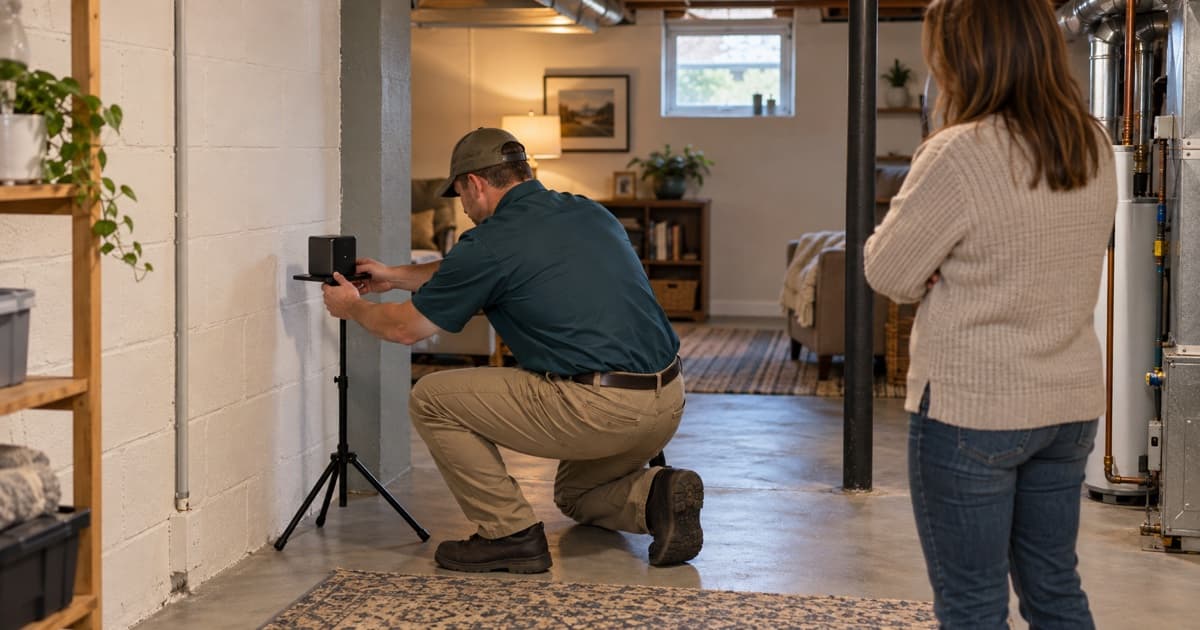
A qualified tester selects the measurement location for the decision at hand, documents conditions and uses an appropriate device. In a real-estate transaction, a continuous monitor or paired devices may help identify interference and support a deadline. A homeowner can also obtain a legitimate result with an approved kit when the instructions are followed carefully.
For local testing help, submit a request through our referral form. With your consent, we can share it with one participating independent radon service provider, who confirms the scope and performs any service you agree to. Our DIY-versus-professional guide compares the choices without treating a store-bought kit as second-rate.
Placement and timing make the number useful
EPA's buyer and seller guide calls for testing on the lowest level that could be used regularly. That may be a finished basement family room, a lower-level bedroom or the first floor when the basement is not suitable for occupancy. Kitchens, bathrooms, laundry rooms, crawlspaces and drafty spots are poor locations.
Short-term tests used for a time-sensitive decision run for at least 48 hours, although some devices require longer. Closed-house conditions generally begin before the test and continue during it. Long-term tests run more than 90 days and better represent a year-round average. Severe storms and high winds can undermine a short short-term test, so follow the device and current agency instructions rather than improvising.
- Record the device, location, start and stop times.
- Keep exterior doors and windows closed except for normal entry and exit when instructions require closed-house conditions.
- Do not move the device or place it near high heat, humidity or strong airflow.
- Keep the report; a mitigator will want to know what was measured and where.
What happens after an elevated result
First, confirm that you understand the device, duration and conditions. The appropriate confirmation path depends on whether the result came from a long-term test, a short-term home screening or a time-limited real-estate test. The guide for results above 4 pCi/L lays out those branches.
Once the result supports action, a qualified mitigator evaluates the foundation and proposes a system. Active soil depressurization is common, but the number and location of suction points, crawlspace treatment, sump details and vent route belong to the property—not to a generic package. Follow-up testing checks whether the completed system reduced the level.
Sources
Primary guidance used for this article
We use government and public-health sources, distinguish historical datasets from current household measurements, and do not invent local results. Read our editorial policy.